
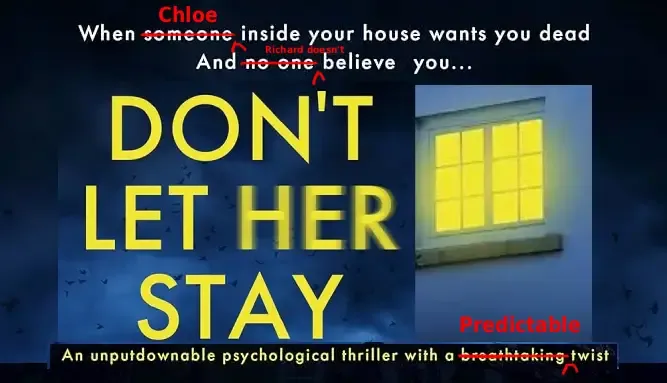
Before you buy. Plot holes, pros, and cons of Don’t Let Her Stay by Nicola Sanders; a gripping novel for most readers.
Introduction to the narrative
The author, Nicola Sanders, builds the story’s setting by elaborating on how the protagonist, A.K.A. Joanne, spends her life with a newborn in a mansion-like house. The only visitors she often gets are the good-looking gardener, Simon, and the stereotypically unbothered cleaner, Roxanne. Joanne’s day-to-day life is monotonous and filled with baby-related chores. Previously a real estate agent, she is now a full-time mom and finds solace in awaiting her husband’s arrival at night. Her husband, Richard, a widower and one-time divorcee, is in his 40s, yet he is capable of sweeping any young woman off her feet.
Their lives change when his twenty-year-old daughter from his first marriage sends them a letter, asking to stay at their place for a few days. Thrilled, Joanne and Richard welcome the estranged girl into their home. After Chloe arrives, she displays a series of questionable behaviors, and tries to make Joanne a forgetful person who’s going insane just like her mother.
Critical analysis
Characters
Joanne, the protagonist, is written as a typical woman who is insecure about her current state, in terms of her physical appearance and inability to work with the baby. Obviously, she seems like a paragon of motherhood, sacrificing everything in her life to take care of her baby. However, from the beginning to the end of the story, there is no character arc whatsoever except for her being a pushover. As readers, we are dumbfounded by most of her decisions throughout the story. Regardless of the dreadful atmosphere created by Chloe, an outsider, I might add, Joanne acts as the outsider herself. In all my years of reading, Joanne must be the weakest woman and mother I have ever encountered. Mothers are vicious and protective when it comes to their children, and Joanne is not one of them.
When it comes to Richard, he is introduced as the most loving, caring, and honest husband in the entire world. His minor jealousy and anger issues aside, he was never shown as a character with maniacal behaviors. Although he had believed and loved Joanne for many years, after Chloe’s arrival, he flips and chooses to believe her instead of his wife. As absurd as this sounds, he knows Chloe’s past well enough to keep her at arm’s length. Although Joanne mentions that Richard is a genuine father, again, the reader is staggered by Richard’s decision-making ability, supposedly a protective father and husband.
From the very first sight, Chloe is portrayed as a spoilt brat. She is psychotic, maniacal, and disturbed by birth. As it turns out, she wasn’t traumatized by her unfortunate childhood, but the people around her had to pay the price because of her unhealthy obsession with her father. Her irritating characteristics are flawlessly written, and as insufferable as her actions are, she is crafted to be mysterious—almost like a devil’s spawn, which is a plus point, if you will.
Plot
As the title suggests, it is a no-brainer that “Her” is Chloe, and yes, Joanne and Richard shouldn’t have let Chloe step into their home. (Plot summarized then and there in the oh-so mysterious title)

Joanne isn’t aware of Chloe’s past except that she threw a fit right before their wedding—
threatening her father that she would kill herself if he proceeded with the wedding to Joanne. However, Richard dismisses her obnoxious act and starts a new life with his new bride. As the days go by, Joanne realizes that Chloe isn’t the sweetheart she is cracked up to be. Whenever Richard isn’t around, Chloe’s mask falls off, and she starts insulting Joanne by first calling her Joanna instead of Joanne and making her think as if she’s losing her mind.
Before Chloe’s arrival, Joanne had already met up with the perfect babysitter to take care of her daughter since she plans to work from home. But, when Chloe arrives, she naturally offers Joanne to babysit Evie, which Joanne refuses. Be that as it may, Richard practically forces Joanne to agree and starts gaslighting her just like Chloe. The same father who would die for his baby daughter, and the same father who is well aware of Chloe’s dark past.
When the story is unveiled, the reader gets to know that Richard’s first wife had committed suicide soon after their three-month-old infant passed away. To top it all off, Richard knows that Chloe had something to do with his previous wife’s and daughter’s untimely demise, yet he decides to take Chloe in and let her babysit Evie. If Richard were a normal human being, he would trust Joanne’s instincts: better yet, he should have taken a restraining order against his mentally unstable daughter, let alone give her access to his family. Let us not forget the fact that Richard was afraid of Chloe, just an eleven-year-old kid, and decided to institutionalize her due to her erratic behavior. Then, why would he let her set foot within a hundred yards of his family?
As mentioned in the characters’ section, Joanne is nothing short of a mother if she is hell-bent on protecting her child. Joanne knows that she puts on this “mask” and masquerades as a little girl in front of her father, and displays opposite behavior in front of her. After a couple of years, Chloe magically craves to reconnect with her father and spend time with her baby sister, Evie. What’s worse, sometimes Chloe freaks out and runs out of the room while shoving Evie in Joanne’s arms, uses Joanne’s bicycle without her permission, converses with Roxanne while seemingly criticizing Joanne, and, crucially, makes Joanne and Richard believe that the former is severely forgetful and going crazy like her mother. How aren’t these clues ringing any alarm bells in any sane person?
Even after she is fully aware that Chloe is not the angel she pretends to be in front of her father, and when her husband vehemently discounts everything she brings up on Chloe, she doesn’t pack her bags and leave the house immediately, as any sensible mother would do.
The only rational thing Joanne does is install cameras all around the house, thereby allowing her to gather incriminating evidence that Chloe is actually about to do something out of the ordinary. But, once Chloe coaxes Joanne to reveal her phone’s PIN, Joanne completely forgets to change it — as we, the readers, would anticipate as her next move. Needless to say, as predicted, Joanne is so out of her mind that she doesn’t change her phone’s PIN, even though there is a psycho loose in her home who probably wants her and her infant dead. Consequently, Chloe deletes the footage that recorded her bizarre behavior.
Later in the story, however, Joanne uncovers a lot of suspicious information about Chloe, but begins to trust her just because Chloe claims her father is the real murderer in the house. In the latter part of the story, Joanne asks Chloe a significant number of questions to get some closure for her strange actions. One is the harrowing act of photoshopping Joanne and Simon together in an intimate manner to threaten and manipulate her. Chloe justifies the act by telling Joanne she only did it to drive Joanne away from her deranged husband and to protect her, which Joanne buys. It is ridiculous that Chloe has an answer for every action of hers and conveniently convinces Joanne, the woman she disrespected, manipulated, and threatened a couple of hours ago. Not to our surprise, Joanne credulously assumes that Chloe is innocent.
The subplot of dead fish in Richard’s fish pond falls completely flat as well. When Joanne got to know that the fish in the pond were dead, she must have known that somebody else had poisoned them. Joanne only realizes this point after it’s much too late. Even if Richard were the most dangerous axe murderer in the country, he wouldn’t have to kill his own fish, which he had individually named and adored. He does not have any motive to kill his own fish. If Joanne were an average human being with common sense, she could’ve figured out that Chloe was behind it. This fact itself foreshadows the so-called predictable twist.
Even after Richard is shot dead by Chloe, she turns to Joanne with the shotgun as if the job isn’t done. This involuntary reaction from Chloe emphasizes that she is, in fact, the killer and will only continue to destroy—a crucial point again dismissed by Joanne.
The bottom line is that neither Joanne nor Richard is responsible, or ordinary human beings for that matter. Their primary instinct must not be reconnecting with Chloe, a mentally unstable person, someone they hardly even know.
Verdict - Is it worth reading?
Overall, the characters of this book are poorly written, except for Chloe. Sanders was able to create a textbook psychopath who is extremely unnerving. Honestly, Chloe’s demeanor is unbelievably annoying and unfair to the point that, as a reader, I was physically upset. However, the other characters are outright laughable and produced lots of sighs and scoffs on my part. Not only does this make you wonder how you would react in a similar situation, but it also compels you to pull your hair out.
Yes, without a doubt, it is unputdownable and certainly not boring because it resembles a soap opera filled with drama. You cannot physically put this book down since you will be angry half the time, and you want to get it over with. Your frustration will be further amplified when you notice that the author is reluctant to use a variety of similes. For example, how many times must you mention that Joanne’s face is flushed like a beetroot?
As both a writer and a reader, one of my biggest pet peeves is when a writer assumes the reader is dumb or when they spoon-feed you every little detail, so there’s nothing left to the imagination. Truth be told, this book excels at doing just that.
On the other hand, the so-called twist that the author flaunts so grandly is, oh well—a bust. The reason? Don’t Let Her Stay is uncomfortably predictable; we know Chloe is the killer, and yes, she turns out to be (drum roll), the killer.
In a nutshell, it’s an okay book. A book that, unfortunately, presumes the reader is a five-year-old child whose predicting game is abysmal.
Rating: 5/10